Twelve Thousand, Five Hundred Buildings. One Hammer.
England has roughly 12,500 higher-risk buildings that need facade safety evidence under the Building Safety Act — and the industry's default inspection method is a trained ear and a hammer that can only ever reach one tile at a time.
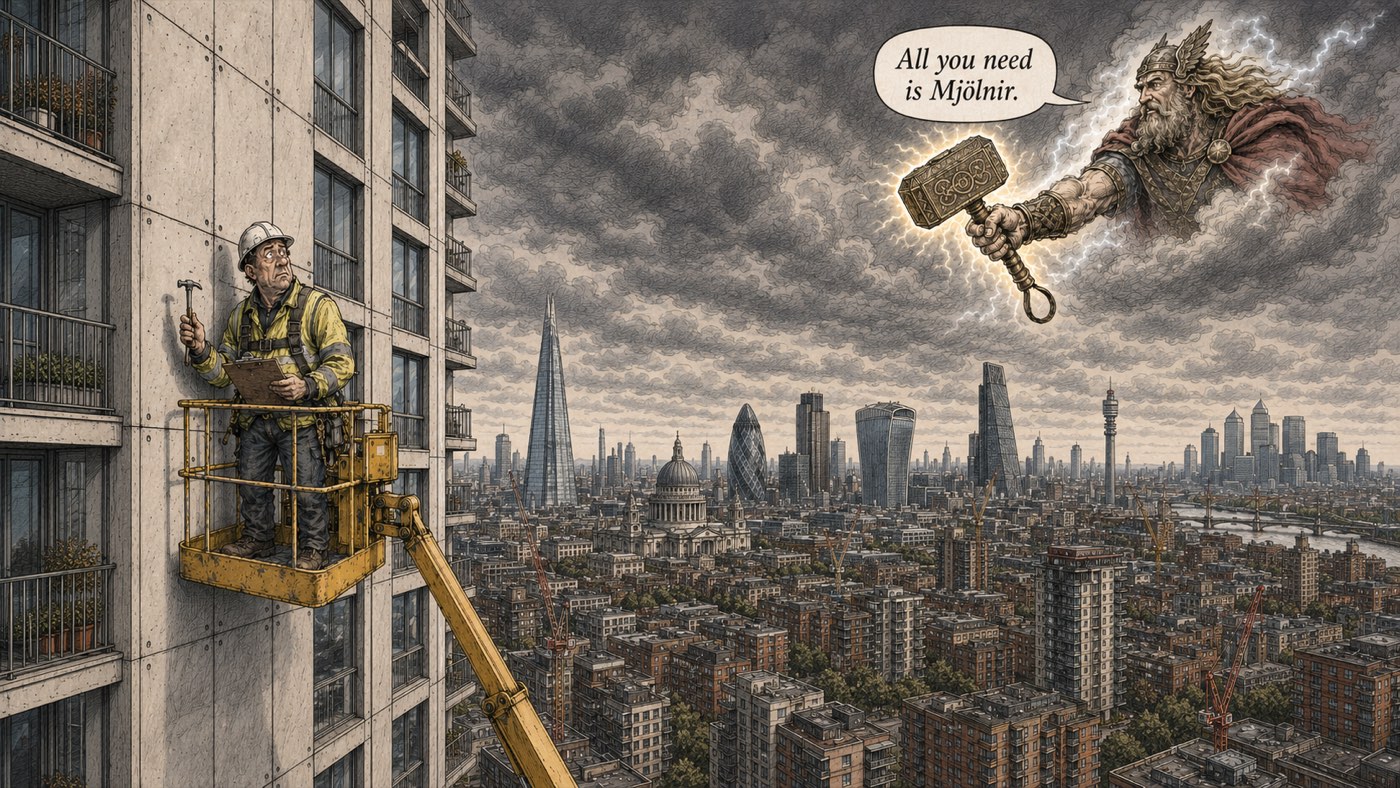
That is the arithmetic of façade compliance in England right now. The Building Safety Regulator's registration window closed in October 2023 with approximately 12,500 higher-risk residential buildings on its books, every one of them requiring a documented assessment of its external wall condition under the Building Safety Act 2022. And the primary tool the industry reaches for, embedded in decades of professional practice, is a trained operative on scaffold striking tiles one at a time and listening for the difference between a solid sound and a hollow one.
The method is not wrong. The problem changed size.
What Delamination Is and Why It Hides
Delamination is not a crack. It is not a surface stain. It is a bond failure, a loss of adhesive contact between the tile body and the cementitious substrate behind it that creates an enclosed air void between two apparently intact surfaces.
That void is invisible from the street. The tile or brick face looks completely normal. The grout lines are intact. There is no outward sign of distress until the tile falls.
The failure mechanisms are well understood. Ceramic and stone tiles have a coefficient of thermal expansion of 6–8 millionths per degree Celsius. The cementitious substrate behind them expands at 10–12 millionths per degree Celsius. On a UK façade, temperature swings between a winter night and a summer afternoon can exceed 50°C. Over thousands of annual thermal cycles, the differential movement between tile and substrate progressively fatigues the adhesive bond, in much the same way that bending a metal wire back and forth eventually snaps it, even though no single bend appears catastrophic.
Moisture compounds the damage. Water penetrating hairline cracks in grout lines migrates behind the tile face. When it freezes, it expands by approximately 9%, applying direct pressure to the bond area. Each freeze-thaw cycle enlarges the void slightly. Each enlargement accelerates the next cycle of thermal fatigue.
The result is a defect that is self-concealing and self-accelerating, hidden behind a face that looks intact, growing faster as it grows larger.
Why the Hammer Tap Test Works
The percussion sounding method, what building professionals call the hammer tap test, or the coin test, is a legitimate application of acoustic resonance physics. It has earned its place in professional practice.
When a tile is struck, it vibrates. The resonant profile of that vibration depends on its boundary conditions, specifically, what the tile is mechanically coupled to on the other side of its back face.
A tile with an intact adhesive bond is acoustically coupled to the mortar and substrate behind it. The combined system has high acoustic impedance. The strike produces a dense, short, damped sound. Vibration energy transfers rapidly into the substrate.
A tile with a delamination void behind it is acoustically isolated. It vibrates as a free plate over an air cushion. Acoustic impedance is low. The strike produces a hollow, reverberant sound, longer in duration, higher in pitch. The operative hears the tile resonating independently of anything behind it.
This is real physics. In controlled conditions, a single building, a quiet morning, an experienced operative with full scaffold access and the time to work methodically, percussion sounding produces useful, reliable results. It has been the professional standard for individual building condition assessment for decades for exactly this reason.
The method has three characteristics that matter to what follows. It requires physical proximity to every tile assessed. It produces an analogue judgement, "hollow" or "solid," rather than an instrument reading. And it leaves no digital record beyond a mark on a drawing.
These are not flaws. They are design characteristics of a method built for a specific context.
The Arithmetic That Does Not Work
A 20-storey residential tower with a fully tiled façade presents 3,000 to 5,000 square metres of tile or brick surface requiring assessment. A professional operative working carefully on scaffold, striking tiles, recording observations, moving systematically across each panel, covers 60 to 80 square metres per day. That represents 40 to 80 operative-days of assessment time per building, before scaffold erection, strike planning, and occupier notification are counted. Add sequential scaffold moves across four building faces, and a thorough sounding assessment of a single tower realistically takes ten to sixteen weeks on site. Now multiply by 12,500 buildings.
The inspection industry that grew up maintaining these buildings, assessing them individually, on planned five- or ten-year cycles, with time to mobilise properly, was sized for a world where a few hundred new buildings entered service each year. It was not sized for a world where twelve thousand existing buildings require structured safety evidence simultaneously, on statutory timescales that the Building Safety Regulator is now actively enforcing.
This is not a resourcing challenge that better procurement can solve. Training a qualified building surveyor or certified rope access technician takes years. The workforce does not exist at the scale the arithmetic requires. And unlike most capacity problems, it cannot be resolved by hiring faster.
The constraint is not skill or will. It is physics. Physical access to every tile is a hard requirement of the percussion sounding method, and that requirement makes the scale impossible.
The Same Void, Detected by a Different Physical Property
The air gap that the operative's hammer detects by sound has another physical signature, one that does not require anyone to stand in front of it.
Every material has a property called thermal effusivity: a measure of its ability to exchange heat with its surroundings. It is the product of thermal conductivity, density, and specific heat capacity. The ratio between mortar and air is 200 to 1.
That ratio is the diagnostic mechanism. When solar radiation heats a tile façade, heat conducts from the tile surface inward toward the substrate. Where the bond is intact, that heat flows through the high-effusivity mortar into the substrate, which acts as a thermal reservoir, absorbing heat and moderating the tile's surface temperature.
At a delamination void, the heat reaches the air gap and encounters a near-total thermal barrier. Air cannot conduct heat. The tile above the void heats faster, rises to a higher surface temperature, and retains that heat longer. It registers as a warm patch against cooler surrounding tiles, a surface temperature differential of 1 to 5 degrees Celsius during active solar loading conditions.
A modern radiometric thermal camera achieves a Noise Equivalent Temperature Difference of 0.03 to 0.05 degrees Celsius, two orders of magnitude more sensitive than the signal it needs to detect.
The detection conditions are predictable and schedulable. The maximum thermal differential for solar-heated façades occurs one to two hours after peak solar flux, typically in the early-to-mid afternoon. For the passive cooling cycle, the maximum contrast appears in the evening and early night, as delaminated areas lose their trapped heat faster than the thermally coupled surroundings.
These are not laboratory conditions. They are the ordinary physics of a building façade on an ordinary day, observable at distances of 10 to 30 metres, without scaffold, without physical contact, with a calibrated instrument whose measurements are traceable to recognised standards.
The hammer detects the acoustic signature of the void. The radiometric sensor detects its thermal signature. Same void. Different physical property. One requires proximity. The other does not.
What the Building Safety Act Actually Requires
The choice of inspection method is no longer a matter of professional preference or cost optimisation. The Building Safety Act 2022 defines what constitutes adequate evidence, and that definition has specific implications for the class of method that can produce it.
The Golden Thread obligation requires that building safety information be stored digitally, maintained throughout the building's lifecycle, and accessible to the Building Safety Regulator on demand. It must be sufficient to demonstrate that safety risks are being actively managed, not at a point in time, but continuously.
Percussion sounding generates a subjective auditory judgement. It produces marks on a drawing. It has no calibration protocol, no instrument reading traceable to a measurement standard, and no inherent comparability between operatives or between inspection cycles. Two assessors may reach different conclusions on the same tile. The same assessor may reach different conclusions on different days.
Radiometric infrared thermography generates calibrated, georeferenced, timestamped data. The measurements are traceable to recognised units. The methodology is documented. The datasets are comparable between inspection cycles, accessible in standard digital formats, and reviewable by any third party with the appropriate software.
This is not a technology comparison. It is an evidence class comparison. The Building Safety Act does not specify instruments. It specifies what the evidence must be able to do.
What This Means in Practice
The hammer tap test remains the right tool for what it was designed to do: assess an individual building, with scaffold access, on a planned cycle, with time to work methodically. Nothing in this article changes that.
What it cannot do is produce the volume, format, and comparability of evidence that twelve thousand buildings now require simultaneously, on statutory timescales, at a scale the available workforce cannot physically reach.
The inspection industry did not fail to prepare for this. The legislation created the obligation faster than the industry could adapt its methods. The gap is not a question of competence. It is a question of scale.
Building owners, principal accountable persons, and appointed building safety managers facing BSA compliance deadlines need to understand what class of evidence they are producing, and whether it will withstand regulatory scrutiny over the building's lifecycle, not just at the point of first submission. The Golden Thread is not a one-time exercise. It is a continuous obligation.
The physics of the problem has not changed. An air void behind a tile is still an air void. What has changed is the number of voids that need to be found, in the number of buildings that require evidence, on the timescales that compliance now demands.
Physics didn't change. The problem did. And now the method must follow.