The Locked Sky
Why Britain keeps frightening away the future it says it wants — and how a nervous country talked itself out of a generation of engineers.
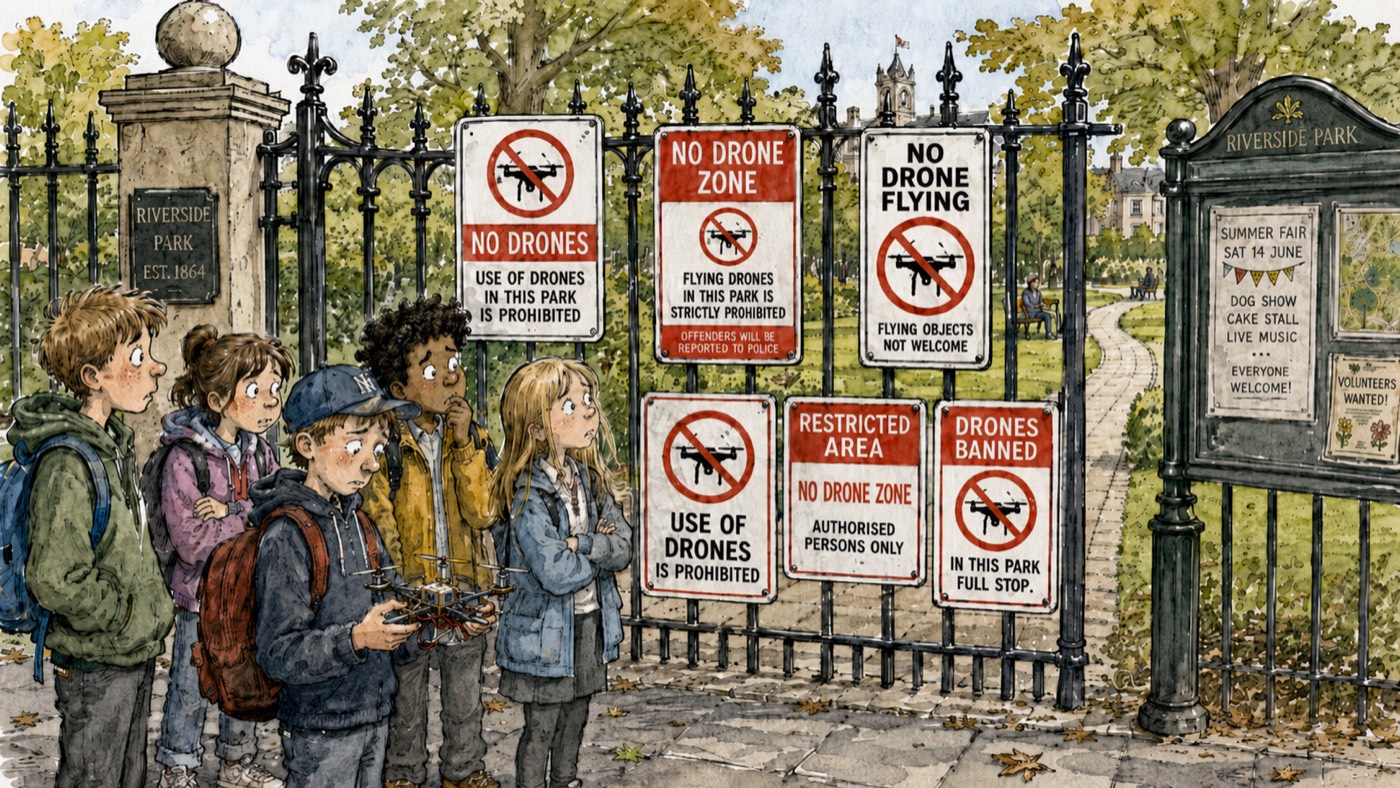
Somewhere in Shenzhen this morning, a sixteen-year-old is soldering a flight controller onto a quadcopter she built from a kit. Somewhere in south London, a sixteen-year-old is reading a sign in a park that tells him, in so many words, not to.
That contrast is the whole argument in miniature.
Britain likes to describe itself as a nation of inventors. We are fond of the word "innovation", and fonder still of the buildings we name after it. But there is a quieter national reflex underneath the branding: when a genuinely new technology arrives, our first instinct is not to ask what it could build, but whether it should be allowed near us at all. We admire the future from a safe distance, and we regulate it up close.
With drones, that reflex has hardened into something more expensive than caution. It has become a mild but persistent hostility to the very innovators the country claims to want.
This is not an argument for recklessness. It is an argument that timidity has costs too — and that we are now beginning to pay them.
The world is not waiting
Consider the pace elsewhere, because the numbers are genuinely striking.
China has decided that the airspace below a thousand metres is an economic zone in its own right. It calls this the "low-altitude economy", and its own civil aviation regulator values it at roughly 670 billion yuan in 2024, rising to an anticipated 1.5 trillion yuan — over £150 billion — in 2025, and 3.5 trillion by 2035. By 2024 the country had registered more than three million drone-related enterprises, was actively managing over a million civil drones, and had issued some 270,000 drone-pilot licences. By the end of 2025 its registered drone fleet had passed three million units, up by half in a single year. China now files around 70 per cent of the world's drone patents. Food is delivered by drone in Shenzhen in fifteen minutes; the city logged more than 700,000 cargo drone flights in a year.
The United States, meanwhile, had certificated more than 427,000 commercial remote pilots by the end of 2024 — up from roughly 331,000 two years earlier — and has well over 800,000 drones on its register. Europe, under a single harmonised framework, has passed two million registered drone operators.
And this is not merely hobbyists photographing sunsets. Zipline, a single delivery company, has now flown past 120 million autonomous miles and two million commercial deliveries — reportedly around 1.8 million of them without a safety incident — carrying more than 22 million vaccine doses and, at one point, over a third of Rwanda's national blood supply. That is not a demonstration. That is infrastructure.
Set against that, Britain's position is peculiar. On paper, the ambition is real: the Civil Aviation Authority has a roadmap towards routine flights beyond the pilot's line of sight by 2027, and PwC's well-known modelling suggests that, in a best-case adoption scenario, drones could add up to £45 billion to the UK economy by 2030, support 650,000 jobs and put more than 900,000 aircraft to work. The headline potential is enormous.
The lived reality is thin. The UK's own commercial drone market is estimated at under a billion dollars today. Walk through almost any British city and you will struggle to find a drone doing visible, useful, unglamorous work. We have written the strategy. We have not built the habit.
The generation we quietly declined to raise
Here is the part that should worry a business audience most, because it is the part that compounds.
There was a window — roughly the last fifteen years — when drones went from exotic to ordinary for young people around the world. In China and the United States, hundreds of thousands of teenagers built, crashed, repaired, modified and raced them. It was chaotic. It was occasionally annoying. It certainly created some risk to the patience of park keepers and the dignity of the operators. And it produced something priceless: a large cohort of young people who understood, in their hands and not just in theory, how flight control, batteries, sensors, radio links, software and cameras fit together.
Britain, out of an entirely well-meant concern for privacy and public safety, largely sat that window out. We protected people from a nuisance and, in the same motion, denied a generation the messy apprenticeship that turns curiosity into capability.
We are now discovering the bill. Britain faces a shortfall of more than 173,000 workers a year across science, technology, engineering and maths — a gap the engineering institutions estimate costs the economy around £1.5 billion annually, and one that has persisted, remarkably, for over fifteen years. Roughly three-quarters of engineering employers report they cannot recruit the people they need. On some projections the country will need around a million more engineers by 2030, even as a fifth of the current engineering workforce heads towards retirement. Meanwhile, uptake of some key technical school subjects has fallen by half in a decade.
You do not close a gap like that with a poster campaign. You close it by letting fifteen-year-olds get their hands on real machines and become quietly obsessed. A teenager who learns to build and fly a drone is not playing with a toy. They are absorbing aerodynamics, electronics, coding, systems thinking, spatial reasoning and — crucially — a practical sense of risk. Those are the exact skills behind the next wave of British robotics, manufacturing and AI. We treated the on-ramp as a hazard and closed it.
A future that wears only a uniform
To its credit, Britain has recently found urgency. In June 2026 the government committed more than £5 billion to drones and autonomous systems — for defence. Given the lessons of recent conflicts, that is understandable and, in its own terms, wise.
But it is a lopsided answer, and it carries a subtle cultural risk. If the only drones the public ever hears about are instruments of war, the country will absorb, at a level below argument, the belief that drones are inherently dangerous, inherently military, and inherently other people's business. Fear becomes the default setting. And a population that fears a technology will not build companies around it.
The larger prize was always civilian, and it is dull in the best possible way: inspecting a bridge before deterioration becomes a closure; surveying a façade before a defect becomes a safety incident; checking power lines without sending people up pylons; mapping flood damage in hours rather than weeks; giving emergency services a picture from above before crews arrive. This is where the volume, the jobs and the recurring revenue actually live. A drone that spots a loose tile before it falls is not a lesser cousin of a defence system. It is a different, quieter form of national resilience.
The toll we pretend we can avoid
The honest objection to all of this is safety, and it deserves a straight answer rather than a comforting one.
Yes: wider civilian drone use will mean more incidents. Drones will fall. Some will be flown by fools. A few will be flown by people with bad intentions. Privacy will occasionally be abused. None of that is trivial, and none of it should be waved away.
But we have made this bargain before, with clear eyes, and been right to.
The motor car did not earn its place in society by being harmless; in its early decades it was lethal and largely unregulated. Society did not respond by banning it. It responded by inventing driving licences, road rules, vehicle testing, insurance and enforcement — an entire operating system for managing a useful danger. Aviation did not expand because every early pilot was competent or every intention pure. It expanded because institutions learned to manage risk at scale. Progress has always carried a toll. The mature response is not to refuse the toll and forfeit the journey; it is to build the systems that keep the toll as low as honestly possible, and then to travel.
Refusing that bargain does not make Britain safe. It makes Britain a spectator.
And here a note of realism is worth adding, because it cuts against easy triumphalism about the East. Even China, having built the ecosystem, is now clamping down hard on ordinary flyers — police are called when a hobby drone powers up, and operators complain that "the sky is locked up" before the promised economy has fully arrived. The lesson is not that anyone has got the balance perfect. It is that the ecosystem and the culture must be built first, while the rules are still forming — because a country that acquires the fear before it acquires the capability ends up with the worst of both: tight restrictions and nothing to show for them.
That is precisely the trap Britain is walking into.
Where this road ends
Play the current trajectory forward a decade and the destination is not dramatic. It is worse than dramatic. It is ordinary decline.
We will not be a country with no drones. We will be a country that buys them — the aircraft, the components, the software, and increasingly the expertise — from the nations that were braver earlier. Our young engineers will train here and build their careers where the interesting work is allowed to happen. We will host the pilot schemes and export the market. We will, in short, rent the future from others while congratulating ourselves on our prudence. A museum can be beautifully curated and still be a place where the living work stopped some time ago.
None of this arrives as a crisis. That is what makes it dangerous. It arrives as a series of reasonable-sounding refusals, each defensible on its own, that together amount to a decision the country never consciously made.
The way back
The answer is not to tear up the rulebook. It is to write a better one, and to write it with ambition rather than anxiety. Three shifts would do most of the work.
First, give the next generation supervised access, on purpose. Drones belong in schools, colleges, universities, maker spaces and youth competitions — treated as a serious route into engineering, AI and robotics, not as contraband. That means accessible components, teacher confidence, and the deliberate creation of controlled spaces where young people can build and fly without a solicitor present. The risk is real and manageable. The alternative — another decade of the same skills gap — is neither cheap nor safe.
Second, open civilian airspace to routine work, not just to demonstrations. Britain has become brilliant at proving that things are possible and hopeless at making them ordinary. We need proportionate, fast pathways for genuinely low-risk public-benefit operations — inspection, monitoring, emergency response, rural logistics — and real civilian test corridors over ports, coastlines, railways and energy networks, not only military ranges. A demonstration asks whether something could work. A market asks who is buying it next month. We need far more of the second.
Third, make the safeguards serious so the freedoms can be generous. Clear rules on who is flying, why, what data is captured, how long it is kept and what happens when someone breaks them. Public confidence is not built by telling people to stop worrying; it is built by showing them the machinery of accountability actually exists. Get that right, and privacy and progress stop being enemies.
The real test for Britain was never whether it could build a drone. Plainly, it can. The test is whether it can build a society confident enough to use one — visibly, accountably, and often — rather than a society so anxious about the future that it quietly teaches its children to be afraid of it.
We still have time to choose the braver country. Not much. But some.
Key figures and sources
- Global commercial drone market: roughly US$30bn in 2024, projected to about US$55bn by 2030 (~10.6% CAGR) on Grand View Research figures; other analysts forecast considerably higher. Treat as indicative.
- China "low-altitude economy": ~¥670bn (2024), projected ¥1.5tn by 2025 and ¥3.5tn by 2035 — Civil Aviation Administration of China, via Xinhua / Chinese government releases.
- China: 3.2m drone-related enterprises, 1.2m managed drones, 270,000 pilot licences (2024); 3m+ registered drones by end-2025 (+50% YoY); ~70% of global drone patents — Chinese state media / DroneXL.
- US: 427,598 certificated remote pilots (end-2024, up from ~331,000); 800,000+ registered drones (early 2026) — FAA Aerospace Forecast FY2025–2045 / Fast Company.
- EU: 2m+ registered drone operators — EASA.
- Zipline: 120m+ autonomous miles and 2m deliveries by Jan 2026; ~1.8m deliveries with zero safety incidents; 22m+ vaccine doses; >35% of Rwanda's blood supply — Wikipedia / DroneDJ / DroneLife / thedronegirl.
- UK potential: up to £45bn GDP uplift, 900,000+ drones, 650,000 jobs, £22bn savings by 2030 (best-case) — PwC, Skies Without Limits v2.0.
- UK drone market today: ~US$0.84bn (2025), forecast ~US$1.48bn (2030) — MarketsandMarkets.
- UK defence commitment: £5bn+ for drones and autonomous systems, June 2026 — UK Government.
- UK skills gap: 173,000+ STEM shortfall per year, ~£1.5bn/year cost; ~76% of engineering employers struggle to recruit; ~1m more engineers needed by 2030; ~20% of the workforce nearing retirement — IET / EngineeringUK / ManpowerGroup / Royal Academy of Engineering.
- CAA routine BVLOS target by 2027 — UK Civil Aviation Authority.