British Aviation Law Quietly Stopped Being About Pilots
On 20 May 2026, the Law Commission published 38 recommendations mapping a legal path to beyond-visual-line-of-sight drone flight. Nobody noticed. Every serious operator should.
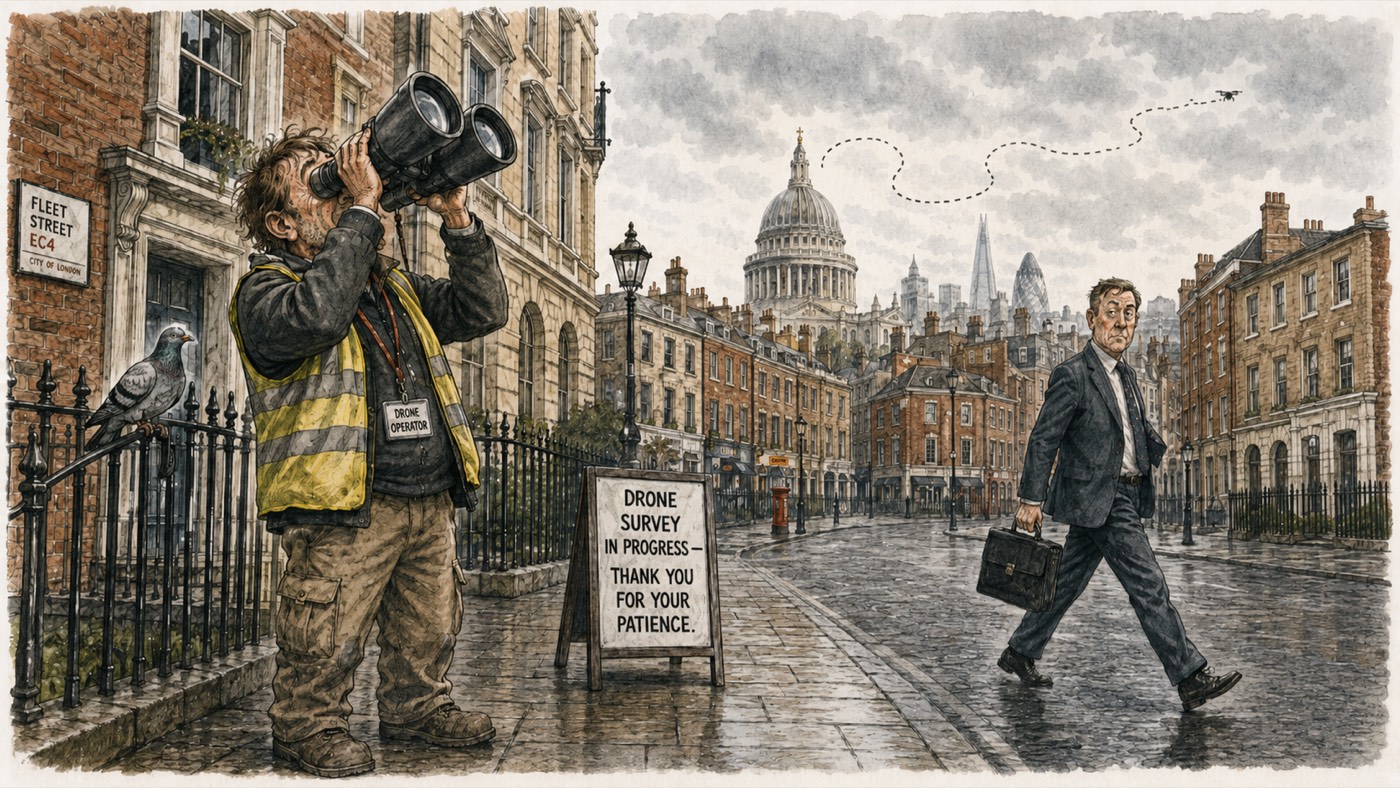
There is a particular kind of frustration that comes from watching technology outpace the rules written to govern it. It is not dramatic. It does not make headlines. It simply accumulates, quietly, in the gap between what is technically possible and what is legally permitted, and it costs money every single day.
For the better part of a decade, that gap has had a name in the British drone inspection industry: BVLOS.
Beyond Visual Line of Sight. The moment a drone moves outside the direct, unaided view of the person operating it. Around a building corner. Behind a roofline. Beyond the far edge of a structure too large to observe from a single vantage point.
The rule was straightforward and the intention behind it was entirely reasonable: if you cannot see your aircraft, you cannot guarantee you are flying it safely. What nobody fully anticipated, when those rules were written, was how thoroughly that logic would collide with the practical geometry of buildings.
A residential block has four sides. A U-shaped housing development has more. An industrial complex, a multi-wing estate, a structure with internal courtyards and re-entrant angles, these are not exotic edge cases. They are ordinary buildings. And for years, surveying them completely with a drone has required either stationing additional observers at every point where the aircraft would leave direct view, or simply not doing it at all.
Meanwhile, the technology moved on. Collision-avoidance systems became genuinely reliable. Georeferenced flight planning made autonomous navigation around complex structures routine. The aircraft could go around the corner safely. It always could, eventually. The constraint was never the machine. It was the law, and the law had not caught up.
The document that changes the calculation
On 20 May 2026, the Law Commission of England and Wales published the final report of a three-year review into aviation autonomy. Three years of consultation, analysis, and legal drafting, involving the Civil Aviation Authority, the Department for Transport, aerospace manufacturers, drone operators, insurers, legal experts, and regulators from across the sector, condensed into 38 recommendations and a clear direction of travel for British aviation law.
It is not the kind of document that trends on social media. It will not be discussed on morning radio. But for anyone with a professional interest in what drones can legally do in the United Kingdom, and particularly for anyone whose business depends on using them to inspect, monitor, and assess the built environment, it is the most significant regulatory document published in this sector in a decade.
Its central argument is elegant and, once stated, obvious: the existing legal framework for aviation was built around the assumption that an aircraft contains a human being. Remove that human being, place them on the ground, or remove them from direct supervisory control altogether, and the law develops gaps. Responsibilities that were assumed rather than written down. Liabilities that were clear when the pilot was in the cockpit and murky when they were not. Safety requirements designed for one operational reality being awkwardly applied to another.
The report does not propose tearing down the existing framework. It proposes filling those gaps, methodically, carefully, and with explicit attention to maintaining the safety standards that make British aviation worth operating in.
The corner, solved
The most immediately practical consequence of the report for drone inspection is the BVLOS question.
The report maps, for the first time, a clear and legislatively grounded authorisation pathway for beyond-visual-line-of-sight operations. Not a free-for-all. Not a relaxation of safety standards. A defined route: through the specific operations category, using a structured risk assessment framework, with aircraft demonstrably capable of autonomous navigation and collision avoidance, operated by businesses that can show they have the systems and procedures to manage the additional complexity responsibly.
The practical effect, once the Government accepts the relevant recommendations and the Civil Aviation Authority develops the technical detail, is a fundamental change in what a drone inspection mission looks like. A complete perimeter survey, all elevations, every corner, the full geometry of a complex structure, becomes a single coherent operation rather than a logistical exercise in deploying enough human observers to maintain continuous visual contact.
This is not a marginal improvement. For the inspection of large residential estates, industrial assets, infrastructure, and the thousands of buildings currently under scrutiny under the Building Safety Act 2022, it is the difference between systematic, complete, cost-effective condition monitoring and an expensive approximation of it.
The report also addresses, through Recommendation 5, the question of one operator managing multiple aircraft simultaneously. Until now, this has been legally undefined in a way that made it uncomfortable to rely on commercially. The recommendation provides clarity: where the CAA authorises it, a single remote pilot can lawfully manage more than one aircraft at a time, with operational safeguards determined by the regulator on a case-by-case basis. For portfolio-scale inspection work, annual condition surveys across hundreds of buildings, this changes the economics in ways that make truly systematic coverage viable for the first time.
The business of being accountable
Beneath the operational changes lies something structurally more important: a formal legal architecture for what it means to be a professional UAS operator.
The report establishes the operator, the company, the business entity running the operation, as a distinct legal subject with its own codified responsibilities. A functioning safety management system. An operations manual. Qualified personnel. Fatigue risk management. Continuing airworthiness oversight. Emergency procedures. The full apparatus of accountable, auditable operation.
This matters because it creates, for the first time, a legally meaningful distinction between a professional inspection business and an individual with a registered drone. Not a marketing distinction. Not a voluntary accreditation. A distinction built into the regulatory framework itself.
For the clients of inspection services, housing associations, asset managers, developers, local authorities, this is clarifying. When the Building Safety Regulator asks for evidence of a building's façade condition, that evidence needs to come from somewhere credible. The emerging legal framework is beginning to define what credible means in operational terms, and the bar it is setting is not low.
Data as the new currency of trust
Two of the report's 38 recommendations require flight data recording to be mandatory for autonomous operations. The logic is straightforward: when no human observer is present to account for an aircraft's behaviour in real time, the record of that behaviour becomes the proof of safe and compliant operation.
But the data question reaches much further than the specific recommendations about recorders. The entire architecture of the reformed framework, authorisation processes, insurance risk assessment, regulatory oversight, liability allocation, depends on operators being able to produce structured, verifiable, time-stamped records of what their aircraft did, where, and under what conditions.
For building inspection, the implication is this. The difference between a georeferenced thermal scan tied to a specific location, elevation, and date, with a complete mission log, repeatable methodology, and year-on-year comparison capability, and a PDF report with photographs is not merely a difference in product quality. It is increasingly a difference in regulatory currency. One satisfies what the reformed framework requires. The other does not, and the distance between them is only going to widen.
The insurance market has already reached the same conclusion. Lloyd's, the Lloyd's Market Association, and the International Underwriting Association all contributed to the Law Commission's consultation process. Their consistent message: operational data is the prerequisite for accurate risk pricing. The report's Recommendation 29 formalises this, requiring that the Government's UAS insurance review explicitly address data access as a central issue. The commercial consequence is predictable, operators who can produce verifiable operational histories will access better insurance terms, and clients who manage large property portfolios will have a direct financial incentive to procure from those operators rather than those who cannot.
The property question
One recommendation deserves particular attention from anyone who operates drones in dense urban environments, which is to say, anywhere that building inspection actually happens at scale.
Section 76 of the Civil Aviation Act 1982 has provided a degree of legal protection for drone operators against trespass and nuisance claims, a recognition that low-altitude flight over private property is sometimes unavoidable and ought not to be automatically actionable. Recommendation 30 proposes to make that protection conditional. It would apply only where the operator is complying with aviation legislation specifically designed to prevent unnecessary intrusion into a claimant's land.
In practical terms, this means that the legal shield for urban drone operations is no longer simply a function of flying at a reasonable height. It becomes a function of operating within a documented, authorised, compliant framework. A mission with a valid authorisation, a georeferenced flight plan, and a demonstrable record of staying within approved parameters is protected. A mission without those elements is exposed.
In the parts of London, Birmingham, and Manchester where the Building Safety Act's attention is most concentrated, dense residential areas, high-rise estates, complex mixed-use developments, this distinction will not go untested.
What comes next
The Government is expected to respond formally to the report by May 2027, setting out which of the 38 recommendations it accepts, rejects, or intends to implement in modified form. The Civil Aviation Authority will then develop the technical detail, updated authorisation criteria, certification standards, operational guidance, that translates legislative intent into operational reality.
The realistic timeline for the full reformed framework to be in force is somewhere in the 2027 to 2029 range. Some elements will arrive earlier, through secondary legislation and updated CAA guidance. Others will take longer, dependent on international standards development and the accumulation of operational evidence.
That timeline is not a reason to wait. It is a reason to move.
The operators who will benefit most from this framework are not necessarily the largest or the most technically sophisticated. They are the ones who recognise, right now, that the report has described a professional standard, and who decide to build toward it before it becomes a requirement rather than after. Safety management systems that exist on paper exist for a reason. Digital output architectures that produce genuinely structured data produce it because the market demands it. Authorisation track records accumulate one mission at a time.
The Law Commission has spent three years mapping the future of drone operations in the United Kingdom. It has been careful, thorough, and genuinely useful work. The map is now public.
The question, as it always is, in any industry facing a regulatory inflection point, is simply who reads it first.