The Friday Afternoon Britain's AI Went Dark — And Why a Letter From DC Should Worry Us More Than Any Cyberattack
Here is a question no British executive expected to be asking in 2026 — if Washington can switch off our AI on a Friday evening, should we be running Chinese open-source models on our own servers instead? Uncomfortable question. After last week, a serious one.
What happened
On Friday at 5:21pm Eastern, Anthropic received a letter from the US Commerce Department, signed by Secretary Howard Lutnick. It ordered the company to suspend all access to its Fable 5 and Mythos 5 models for any foreign national, anywhere in the world, including Anthropic's own foreign-national staff, citing national security.
The practical problem sits at the heart of the matter: you cannot ask for a passport at the point of inference. There is no way to cleanly separate American users from everyone else, in real time, across millions of API requests. Unable to comply partially, Anthropic complied completely. It switched the models off for everybody.
Not a cyberattack. Not an outage. Not a technical failure of any kind. One letter, one department, reaching across the planet to switch off infrastructure that organisations in dozens of countries had been building upon.
The disaster that didn't happen. This time
Now the thought experiment every person responsible for a critical system should run this weekend. Imagine a model like this not powering a chatbot, but woven into something the country actually depends on.
Imagine it inside the NHS, triaging referrals, flagging anomalies on scans, prioritising the waiting list that a hospital trust runs each morning. On Friday evening, it stops answering. Not because of a clinical fault. Because of a letter.
Imagine it embedded in the National Grid's balancing systems, forecasting demand and managing load across the network as the evening peak arrives. The model goes dark mid-calculation. The grid does not get a transition period.
Imagine it inside critical national infrastructure more broadly, water treatment scheduling, rail signalling optimisation, port logistics, the unglamorous computational plumbing that keeps a modern country running. None of it was attacked. All of it simply lost the intelligence it had quietly come to rely on.
And imagine it in defence. Britain, like every serious military, is integrating autonomous and AI-driven systems into reconnaissance, logistics, and decision support. Now imagine the most capable model in that stack belongs to a foreign supplier who can be ordered by their government, not ours, to revoke it. A defence capability that a foreign minister can switch off is not a capability. It is a liability wearing a uniform.
None of this is apocalyptic fantasy. It is the ordinary logic of dependency, followed honestly to its conclusion. The models that vanished on Friday were not, as far as we know, holding up any hospitals or any grids. We were lucky. Luck is not a strategy, and it is certainly not a defence policy.
Why it will happen again
The trigger wasn't malice. It was capability. Mythos unsettled Washington and Wall Street precisely because of what it could do, exploit cybersecurity vulnerabilities at a pace without precedent. The more capable a model becomes, the more likely a state decides it is too important to be left freely available. Friday wasn't the exception that proves the rule. It was the rule, arriving early.
And the intervening state need not be ours. We had no say, no notice, no appeal. The infrastructure was switched off by a hand we could neither see nor stay.
The British question
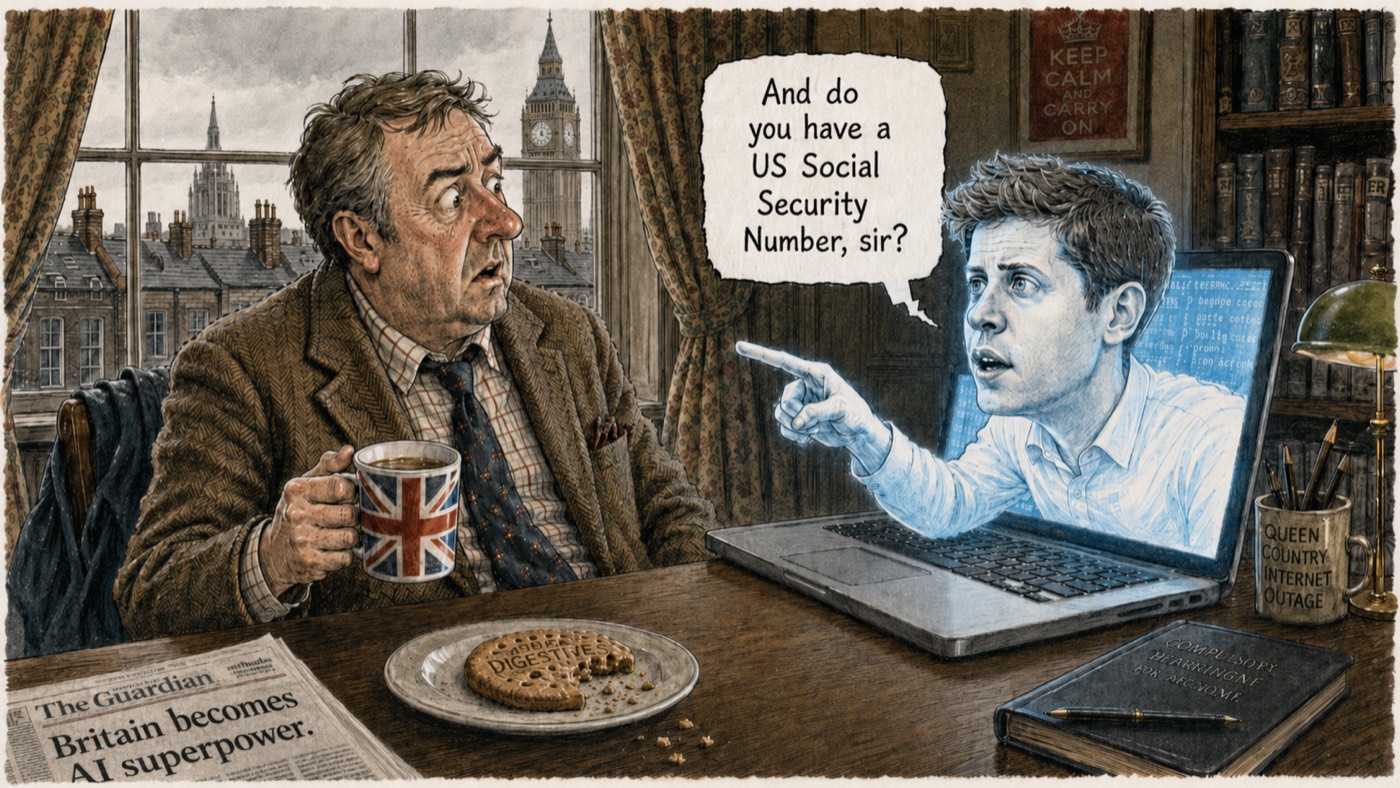
Britain talks of becoming an "AI superpower." Fine. Now the operational question: across the NHS, the grid, defence, transport, water, the systems a nation cannot do without, does Britain have dependable access to frontier-grade AI of British origin? Models that cannot be switched off by a letter from Washington, or Beijing?
For most of our critical systems, the honest answer is no. Until Friday, that felt like an abstraction, a problem for the strategy deck, not the operations room. Friday changed the tense. The vulnerability is no longer hypothetical. It is demonstrated, dated, and documented.
This is the part that should travel beyond the data centre and into the rest of the economy. Anyone building serious tools on top of a foreign frontier model, and in my own field, drone-based inspection and diagnostics for the built environment, a great many of us are, has just watched a live demonstration of what it means to build on rented ground. The lesson is not specific to any one sector. It is general. If your system depends on a model you do not control, you do not fully control your system.
The awkward alternative
Here's the genuinely uncomfortable part, forming quietly in technical teams across the country since Friday.
If the problem with American models is that they can be withdrawn by decree, the obvious fix is models that can't be, because you hold them yourself. And the most capable openly available models, the ones you download in full and run on your own servers, are increasingly Chinese.
Sit with the irony. Fleeing the unpredictability of an ally, Britain reaches for the products of a rival, because the rival's technology, once downloaded, is the more predictable of the two. The American model vanishes on a Friday because of a letter you never saw. The Chinese open-source model on your own servers answers to no letter at all. It does exactly what you tell it, for as long as you choose to run it, because you own the copy. When "the authoritarian option turns out to be the more reliable one" can be said with a straight face in a Whitehall meeting, we have wandered somewhere distinctly strange.
The objections are real and shouldn't be waved away, open weights are not open intentions, and a model's provenance, behaviour, and handling of sensitive data all deserve hard scrutiny rather than reflexive reassurance. A model you can run yourself is not automatically a model you should trust blindly. But at least a model you run yourself is a model that is still running. Sovereignty of operation is not the same as sovereignty of origin, and on Friday's evidence, the first one is what keeps the lights on.
The deeper truth is almost embarrassing in its simplicity. Britain is choosing between depending on an unpredictable ally and depending on a predictable rival, when the whole problem is the depending. Neither is sovereignty. Both are different flavours of someone else's leash.
What Britain actually needs, which is not panic
None of this is an argument for digital isolationism. Sovereignty does not mean autarky, and a Britain that tried to rebuild the entire AI stack behind a wall would only make itself poorer and slower.
What it means is operational independence, the capacity to keep functioning when an external provider becomes unavailable, for any reason: political, commercial, or technical. In practice that points to three things. Genuine investment in domestic frontier capability, of British or closely allied origin, with architectures open enough that critical users are never wholly captive to one vendor's goodwill. Regulatory expectations that treat AI resilience in critical infrastructure the way we already treat data protection and cybersecurity, a condition of serious operation, not an optional extra. And an honest national audit of a question almost nobody has answered: which of our essential systems already depend on foreign models, and what happens to them if those models disappear on a Friday evening.
None of this requires alarm. All of it requires attention. Britain has a long and not entirely flattering history of confusing the two.
The conclusion
A single American letter switched off two of the world's most capable AI models in hours. Britain has no equivalent capability to switch anything on, and its quickest route to independence may involve downloading the work of the very rival its foreign policy spends all day worrying about.
That is not a technology problem. Technology problems have technology solutions, on engineering timelines. This is a sovereignty problem, slower, harder, more political, which is exactly why it must be faced before the crisis, not during it.
Friday was the day it stopped being theoretical. The only question left is whether we treat it as a warning we received cheaply, or one we file politely away to think about after the weekend.
Later has a way of arriving on a Friday evening, unannounced, with the models already going dark.